Night Circus By Erin Morgenstern
Thursday, February 14, 2013
Circus of Dreams

Your mama is a cow...WHAT?!
Is Your Mama a Llama?
By Deborah Guarino
Illustrated by Steven Kellogg
Wednesday, February 13, 2013
Now that I am five, I know everything.
Room by Emma Donoghue
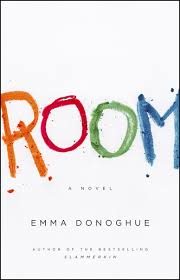
It is Jack's fifth birthday. When he was four, he lived in Room, slept in Bed, ate on Table and played with Ma. He had five book with pictures and five without. He had a few various toys that were made of things such as cans and toilet paper rolls. Ma is Jack's whole world and he is hers. When he is five, everything changes. Ma has another name, many things he thought were just TV are real, outside Room and Skylight is not Outer Space. He thought he know who he was and who Ma was but now everything is confusing. He uses this quote from Alice in Wonderland to describe his confusion, "I hardly know, sir, just at present - at least I know who I was when I got up this morning, but I think I must have been changed several times since then."
It is hard to review this book without giving too much away. It is told from the point of view of a five year old boy. The first part is Jack describing his life in room to us. The last half is Jack's discovery of the outside world. Through his eyes we make all kinds of discoveries, such as "bees and humans should just wave, no touching." We get to feel his first encounter with wind and rain. We get to feel the frustration as he tries to figure out stairs and pulp and all kinds of other things that were previously part of Outer Space.
It is a gripping, funny, disturbing, emotional, philosophical book. At one point Jack thinks, "When I was four I thought everything in TV was just TV, then I was five and Ma unlied about lots of it being pictures of real and outside being totally real. Now I'm outside but it turns out lots of it isn't real at all. Lots of the world seems to be a repeat." It will make you laugh, cry and think. I finished the book two days ago and haven't stopped thinking about it since. I recommend it to all adults.
Thursday, January 17, 2013
9 years later
I like a book that grabs me from the first page. This begins with, “I was born twice: first, as a baby girl, on a remarkably smogless Detroit day in January of 1960; and then again, as a teenage boy, in an emergency room near Petoskey, Michigan, in August of 1974.” It races on from there and never looks back. This book is incredible. You understand within the first few chapters why Eugenides won a Pulitzer prize for it. When I reached the end of this book, I was unhappy to bring it back to the library. I felt I needed to keep it, study it. To be honest, I only picked it up because it had a pretty gold star on it that announced it was a prize winner. I had no preconceived ideas about it. The last hundred pages or so really touch on the hermaphrodite issue. Leading up to it is generations of family drama, heartbreak, success, fears and chromosomal defect. As you are submerged in this book you realize quickly the enormous amount of work Eugenides put into it. It starts in the early 1900's in Smyrna during the Western Front. It follows the protagonist's, Callie or Cal, grandparents as they flee to the United States from the fires the Turks engulf the city with. They settle with cousins in a Greek community in Detroit. It is moves us through the Great Depression, WWII, Detroit Riots, the birth of the hippies and the sexual revolution. It details the care of silk worms, struggles of immigrants, bootlegging, women's rights, the birth of the Motor City, the start up and running of a business, racial segregation, and finally the science behind and emotional struggles of a hermaphrodite. The background and build up to the protagonist is extraordinary. By the time we got to to Callie's story, I was exhausted. I think this book is better digested over a period of a couple of months, not weeks.
I've already explained why this is a history book, novel of emotional struggles and a family saga. It is also philosophical. With quotes like, “Historical fact: people stopped being human in 1913. That was the year Henry Ford put his cars on rollers and made his workers adopt the speed of the assembly line. At first, workers rebelled. They quit in droves, unable to accustom their bodies to the new pace of the age. Since then, however, the adaptation has been passed down: we've all inherited it to some degree, so that we plug right into joysticks and remotes, to repetitive motions of a hundred kinds.” and “Normality wasn't normal. It couldn't be. If normality were normal, everybody could leave it alone. They could sit back and let normality manifest itself.” you begin to believe Eugenides might actually be a genius. It is also vaguely political, touching on issues with Nixon and Henry Kissinger.
This book is a masterpiece and very deserving of its award. I'll leave you with one final thought, that can be appreciated by most in the book world. "I, even now, persist in believing that these black marks on white paper bear the greatest significance, that if I keep writing I might be able to catch the rainbow of consciousness in a jar." No wonder it took him 9 years to write it.
Fum, Fie, Foe, Fee
Monsters Don't Eat Broccoli by Barbara Jean Hicks
 Kids having trouble eating vegetables? Do they carry on endlessly at the dinner table about the "yucky" broccoli? Do they gag and run while you are steaming the cruciferous deliciousness? If any of the above are true, YOU NEED THIS BOOK! The monsters chant repeatedly "fum, fie, foe, fee, monsters don't eat broccoli" while chowing down trees. Then, if you didn't notice the foreshadowing, someone points out at the end of the book they are in fact, eating broccoli. The first time we read this, I read it to my little monsters while they were eating chicken and avoiding large piles of veggies on their plates. By the end of the book, I had them convinced they were horrible, ravenous monsters and they started chanting fum, fie, foe fee while devouring the vegetables! I tote it out ever few month to re-enforce. It occurred to me that maybe the chanting was similar to hypnosis but that is totally ok with me. It works. Try it!!
Just might be doing it wrong...
I recently read this on John Green's web site, "A book is a conversation between a reader and a writer, but we both have to hold up our end of the bargain there. It’s possible to write a book terribly; it’s also possible to read a book terribly. (Witness, for instance, those who read Huck Finn as a defense of slavery.) " It definitely made me wonder. That is one of the goals of this book blog, to make me a better reader. I've been fighting my way through "A Shadow of the Wind" by Carlos Ruiz Zafon. Everyone loves this book. Apparently. So what is wrong with me?! I don't hate it, I'm just not into it. It isn't riveting! It makes me think I might be doing it wrong. It seems that the stuff going on in our lives can determine how we interpret writing. Have you ever read a magazine article that really offends you and the next day, you can't remember why you were so upset about it? I have that sort of trouble with books. I know, for instance, that when I'm pregnant I must revisit old friends. New books will not hold my attention and reading time will be skipped. That could be happening with Zafon's book. I'm reading a few other books (that are more interesting), I don't get enough sleep and reading is the only hobby I have right now. All those put together means the book has to be spectacular (or at least exciting). I'm hoping is going to get better (or I become a better reader).
Monday, December 31, 2012
Are we human because we gaze at the stars, or do we gaze at them because we are human? Neil Gaiman
Stardust by Neil Gaiman
 This book starts out in the town of Wall in England. The Faerie Market is about to begin just outside the gates. Dunstan Thorn, a very ordinary farmer, meets a beautiful and beguiling slave at the market and she gives him a glass snowdrop. Dunstan marries and ordinary girl from Wall but receives a baby in a basket that he conceived with the slave. He names the baby Tristran. We then skip ahead 18 years. Tristran is in love with the town beauty and pledges to find and deliver a fallen star in exchange for her hand in marriage. The adventure begins. Tristran takes off into Faerie to discover many new things. Including, but not limited to, the star is a ethereal girl with the name Yvaine. I love Neil Gaiman's stories and this is no exception. I love that he includes nursery rhymes and interprets them literally. The first we come across is "How many miles to Babylon?"
How many miles to Babylon?
Three score miles and ten.
Can I get there by candle-light?
Yes, and back again.
If your heels are nimble and light,
You may get there by candle-light.
Tristran uses this rhyme and a candle to cover months worth of walking in just a few steps. He also throws in "The Lion and the Unicorn."
The lion and the unicorn were fighting for the crown
The lion beat the unicorn all around the town.
We are introduced to the Unicorn that the moon sends to assist Yvaine and Tristran. The lion and Unicorn were fighting and Tristran steps in as the lion goes in for the kill. Incidentally, the rhyme is about the English Coat of Arms, so naturally I love it. The adventure is a good one; filled with intrigue, faries, ghosts, poison, a race to get the "treasure" and a ship that floats. The twist is a good, though foreseeable, one. In any worthwhile fairy story, things are not what they seem and people are not who you think they are. So, of course, she is not JUST a slave girl. Tristran is not JUST a heart sick teenager, foolishly chasing rainbows (or stars). If this were a story told around a campfire, I would have come away with a euphoric feeling of having just had a magnificent experience. Since it was a book, I am left feeling a bit discontented. I had a similar occurrence after reading Neverwhere. I wanted something more out of it. There were so many wonderful ideas! I wanted to know more about the Lilim. Who were they, what were they once? What about this Castle Fellowship? I understand they were protecting the heir but who are the others? How did they know about him? How did it start? And Captain Alberic and the Perdita!! An airborne ship that harvests lightening?! Fantastic! But I need more! I was left wondering about the Stormhold and Una and wanted a bit of a back story there. What happened with Madam Semele/Ditchwater Sal in her past? And that strange inclusion at the end about Tristran breaking the power of the Unseelie court? More on that as well, if you don't mind Mr. Gaiman. All in all, I enjoyed this book. Would recommend it and read it again. He is an amazing story teller and a talented writer. An extra hundred pages would have made him a genius.

P.S. This is a picture of the Fairy Market by Charles Vess in a 2007 edition of the book. Wish I would have read that one!!
Subscribe to:
Posts (Atom)