Monday, March 4, 2013

Haunted by humans

The Book Thief

The Book Thief is a story about Leisel Meminger.  Death, the narrator, becomes aware of her when she is nine years old.  She was on the train to her new foster family's house in Molching, Germany during the Nazi reign, when her younger brother dies.  While he is being buried, the grave digger drops his handbook and Leisel steals her first book.  Death takes note of her.  The last line of the book is "I am haunted by humans."  Leisel is one of these that haunts him.  Leisel is a special little girl that is trying to survive the horror that she has to live through.  She begins stealing books before she could even read the words, knowing they would lend light to her dismal path.  As she learns to read, she clings to the precious few books she has to escape.  I find myself guilty of the same thing, though I do not steal the books.  How often have I turned to an old leather bound friend to briefly turn away from the troubles before me, emerging refreshed and able to tackle the obstacles.  Leisel focuses on the time spent with Papa and her books and makes it through the rest.
There are other really touching characters in the book as well. I quickly learn to love Mama, even while she is screaming and throwing things. There is a soft spot in my heart for Papa and his gentleness toward a struggling girl.  And then there is Rudy Steiner.  Death says "He does something to me, that boy.  Every time.  It is his only detriment.  He steps on my heart.  He makes me cry."  I can identify with that sentiment.  Every little girl needs a best friend like Rudy.  He took care of Leisel to his own harm in school and out of it.  He stood up for what he believed in.  He stood against teacher, leaders of Hitler Youth and Nazi's.  He gave bread to the Jewish people walking to Dachau and was beaten for it.  I laughed at Rudy's ridiculous adventures and cried with his suffering.  Mostly, I thought we all need someone in our lives that has as much substance as this kid does.  He stands out, he is remembered.  He steps on your heart.

Thursday, February 14, 2013

Circus of Dreams

Night Circus By Erin Morgenstern
“The circus arrives without warning. No announcements precede it. It is simply there, when yesterday it was not.” I'm not actually sure how I feel about this book.  I wasn't going to review it because of that but here I am.  I like it.  I think I do anyway.  Two old "magicians" have an ongoing challenge.  They select two contestants and they compete until the other can't anymore.  These particular contestants are Marco and Celia.  The venue is Les Cirque des Reves.  They create spectacular illusions within the circus attempting to best the other one.  The first half of the book is extremely mysterious.  Things begin to clear up later in the book but there seems to be some ends that do not get tied up.  WHO or WHAT is Alexander?  Who has this weird talent and where do they get it?  Never really a clear answer.  I love Poppet and Widget and their significant to the circus.  I like Kiko and Chandresh as they develop the mystery of the show.  I even like Marco as harsh and devoid of fun as he seems.  I don't really like Celia, however.  She comes off as kind of a flat character.  I wasn't totally unable to connect with her, I just wanted more from her.  It is a great story, great ideas.  I would like to be in or attend such an event!  The plot was not very driven, so it wasn't a terribly exiting book.  Interesting and magical are two words I would use to describe it and that is enough for me to recommend it!

Your mama is a cow...WHAT?!

Is Your Mama a Llama?
By Deborah Guarino
Illustrated by Steven Kellogg

This book was published in 1989, I'm pretty sure I read it to my kid sister in the early 90's!  If taken out of context, it could sound insulting!  Really though, it is about a silly llama that tries to figure out who tries to figure out which animals are the same species as he is.  He questions bats, seals, ducks, kangaroos and a handful of others before he gets it.  Other than just silliness, this book is fantastic for preschoolers.  Great rhyming and repitition.  It also helps kids identify animals by atributes.  I read this to Lula and Doodle while they were occupied with something else and not watching the pictures. They were able to guess most of the animals by their descriptions.  We bought this book so we can read it over and over!

Wednesday, February 13, 2013

Now that I am five, I know everything.

Room by Emma Donoghue


It is Jack's fifth birthday.  When he was four, he lived in Room, slept in Bed, ate on Table and played with Ma.  He had five book with pictures and five without.  He had a few various toys that were made of things such as cans and toilet paper rolls.  Ma is Jack's whole world and he is hers. When he is five, everything changes.  Ma has another name, many things he thought were just TV are real, outside Room and Skylight is not Outer Space.  He thought he know who he was and who Ma was but now everything is confusing.  He uses this quote from Alice in Wonderland to describe his confusion, "I hardly know, sir, just at present - at least I know who I was when I got up this morning, but I think I must have been changed several times since then."
It is hard to review this book without giving too much away.  It is told from the point of view of a five year old boy.  The first part is Jack describing his life in room to us.  The last half is Jack's discovery of the outside world.  Through his eyes we make all kinds of discoveries, such as "bees and humans should just wave, no touching."  We get to feel his first encounter with wind and rain.  We get to feel the frustration as he tries to figure out stairs and pulp and all kinds of other things that were previously part of Outer Space.
It is a gripping, funny, disturbing, emotional, philosophical book.  At one point Jack thinks, "When I was four I thought everything in TV was just TV, then I was five and Ma unlied about lots of it being pictures of real and outside being totally real.  Now I'm outside but it turns out lots of it isn't real at all.  Lots of the world seems to be a repeat."  It will make you laugh, cry and think.  I finished the book two days ago and haven't stopped thinking about it since.  I recommend it to all adults.

Thursday, January 17, 2013

9 years later

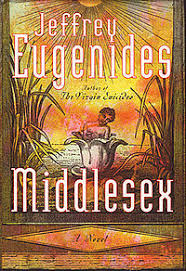
Middlesex by Jeffrey Eugenides

I like a book that grabs me from the first page. This begins with, “I was born twice: first, as a baby girl, on a remarkably smogless Detroit day in January of 1960; and then again, as a teenage boy, in an emergency room near Petoskey, Michigan, in August of 1974.” It races on from there and never looks back. This book is incredible.  You understand within the first few chapters why Eugenides won a Pulitzer prize for it.  When I reached the end of this book, I was unhappy to bring it back to the library.  I felt I needed to keep it, study it.  To be honest, I only picked it up because it had a pretty gold star on it that announced it was a prize winner.  I had no preconceived ideas about it.  The last hundred pages or so really touch on the hermaphrodite issue.  Leading up to it is generations of family drama, heartbreak, success, fears and chromosomal defect.  As you are submerged in this book you realize quickly the enormous amount of work Eugenides put into it.  It starts in the early 1900's in Smyrna during the Western Front.  It follows the protagonist's, Callie or Cal, grandparents as they flee to the United States from the fires the Turks engulf the city with.  They settle with cousins in a Greek community in Detroit.  It is moves us through the Great Depression, WWII, Detroit Riots, the birth of the hippies and the sexual revolution.  It details the care of silk worms, struggles of immigrants, bootlegging, women's rights, the birth of the Motor City, the start up and running of a business, racial segregation, and finally the science behind and emotional struggles of a hermaphrodite.  The background and build up to the protagonist is extraordinary.  By the time we got to to Callie's story, I was exhausted.  I think this book is better digested over a period of a couple of months, not weeks. 
I've already explained why this is a history book, novel of emotional struggles and a family saga.  It is also philosophical.  With quotes like, “Historical fact: people stopped being human in 1913. That was the year Henry Ford put his cars on rollers and made his workers adopt the speed of the assembly line. At first, workers rebelled. They quit in droves, unable to accustom their bodies to the new pace of the age. Since then, however, the adaptation has been passed down: we've all inherited it to some degree, so that we plug right into joysticks and remotes, to repetitive motions of a hundred kinds.” and “Normality wasn't normal. It couldn't be. If normality were normal, everybody could leave it alone. They could sit back and let normality manifest itself.” you begin to believe Eugenides might actually be a genius. It is also vaguely political, touching on issues with Nixon and Henry Kissinger.
This book is a masterpiece and very deserving of its award.  I'll leave you with one final thought, that can be appreciated by most in the book world.  "I, even now, persist in believing that these black marks on white paper bear the greatest significance, that if I keep writing I might be able to catch the rainbow of consciousness in a jar."  No wonder it took him 9 years to write it.

Fum, Fie, Foe, Fee

Monsters Don't Eat Broccoli by Barbara Jean Hicks

Kids having trouble eating vegetables?  Do they carry on endlessly at the dinner table about the "yucky" broccoli?  Do they gag and run while you are steaming the cruciferous deliciousness?  If any of the above are true, YOU NEED THIS BOOK!  The monsters chant repeatedly "fum, fie, foe, fee, monsters don't eat broccoli" while chowing down trees.  Then, if you didn't notice the foreshadowing, someone points out at the end of the book they are in fact, eating broccoli.  The first time we read this, I read it to my little monsters while they were eating chicken and avoiding large piles of veggies on their plates.  By the end of the book, I had them convinced they were horrible, ravenous monsters and they started chanting fum, fie, foe fee while devouring the vegetables!  I tote it out ever few month to re-enforce.  It occurred to me that maybe the chanting was similar to hypnosis but that is totally ok with me.  It works.  Try it!!

Just might be doing it wrong...

I recently read this on John Green's web site, "A book is a conversation between a reader and a writer, but we both have to hold up our end of the bargain there. It’s possible to write a book terribly; it’s also possible to read a book terribly. (Witness, for instance, those who read Huck Finn as a defense of slavery.) "  It definitely made me wonder.  That is one of the goals of this book blog, to make me a better reader.  I've been fighting my way through "A Shadow of the Wind" by Carlos Ruiz Zafon.  Everyone loves this book.  Apparently.  So what is wrong with me?!  I don't hate it, I'm just not into it.  It isn't riveting!  It makes me think I might be doing it wrong.  It seems that the stuff going on in our lives can determine how we interpret writing.  Have you ever read a magazine article that really offends you and the next day, you can't remember why you were so upset about it?  I have that sort of trouble with books.  I know, for instance, that when I'm pregnant I must revisit old friends.  New books will not hold my attention and reading time will be skipped.  That could be happening with Zafon's book.  I'm reading a few other books (that are more interesting), I don't get enough sleep and reading is the only hobby I have right now.  All those put together means the book has to be spectacular (or at least exciting).  I'm hoping is going to get better (or I become a better reader).